

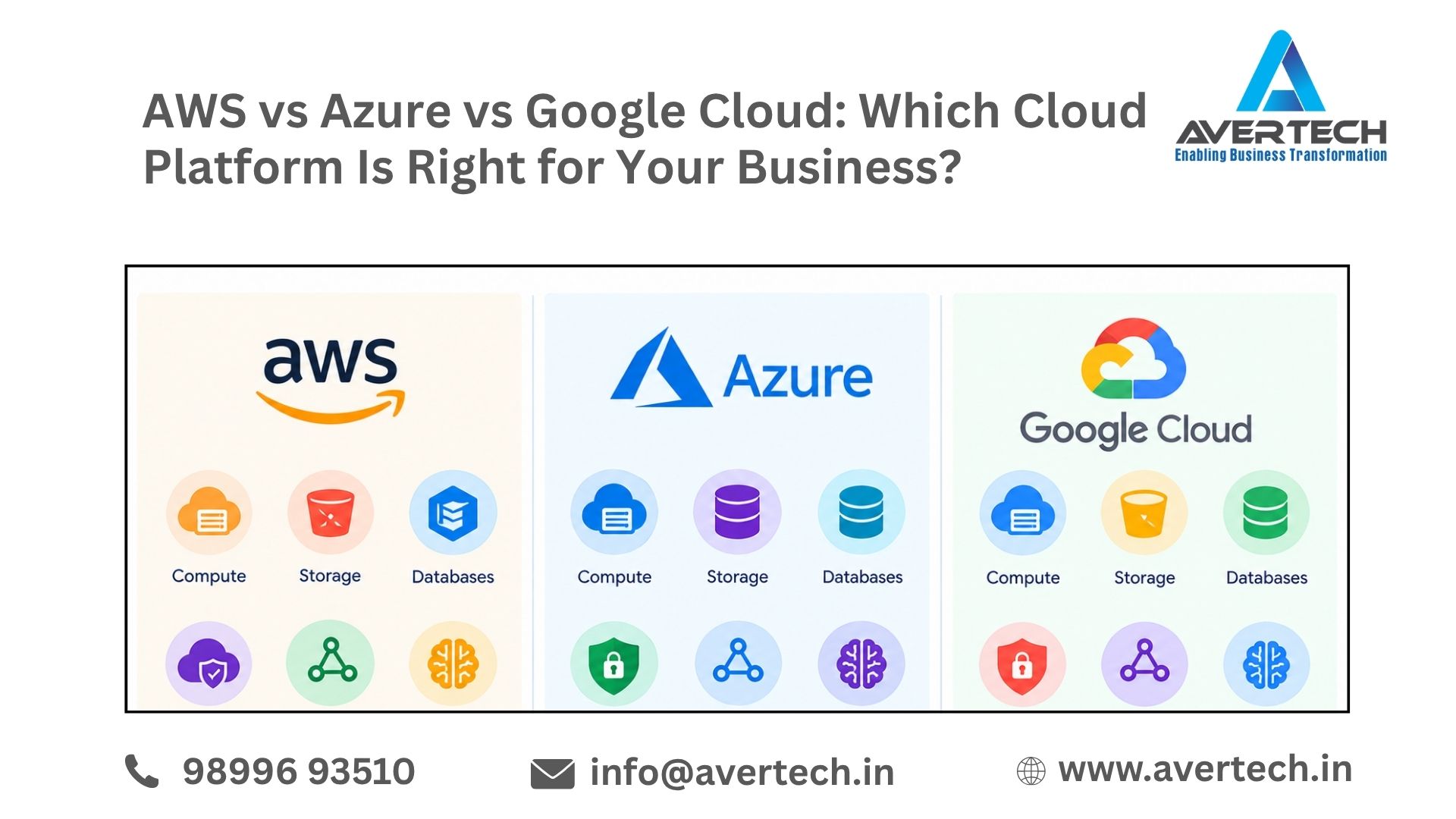
Cloud computing is now an essential part of the business infrastructure. Organizations are able to run a wide range of primary cloud services to host websites and applications, run analytics, AI, databases, backup, and recovery. The three most popular cloud services are Amazon Web Services (AWS), Microsoft Azure, and Google Cloud Platform (Google Cloud).
But which one should your business choose?
The answer is: it depends. Your choice of cloud computing platform comes down to factors such as your application needs, current IT landscape, budget, your technical expertise, your compliance and security needs, and your long-term business goals. Here we discuss the comparison between AWS vs Azure vs Google Cloud, and factors to consider for your choice of cloud platform.
What Is AWS?
Amazon Web Services (AWS) This is the cloud computing platform of Amazon. It provides managed services and infrastructure for cloud computing, databases, security, analytics, applications development, storage, networking, and more. With the use of AWS, customers can generally pay in a pay-as-you-go manner, and some of them can additionally use Savings Plans and other pricing options.
AWS can be used by startups, small businesses, enterprises, software companies, e-commerce platforms, and organizations with large-scale infrastructure requirements.
Key AWS Services
Some commonly used AWS services include:
- Amazon EC2 — Virtual servers
- Amazon S3 — Object storage
- Amazon RDS — Managed relational databases
- Amazon Aurora — Managed relational database engine
- Amazon VPC — Virtual networking
- AWS Lambda — Serverless computing
- Amazon EKS — Managed Kubernetes
- Amazon Cloud Front — Content delivery
- AWS IAM — Identity and access management
- Amazon Cloud Watch — Monitoring and observability
For businesses operating in India, AWS also has infrastructure in Mumbai and Hyderabad, along with other infrastructure options such as Local Zones.
What Is Microsoft Azure?
Microsoft Azure is a cloud platform offering computer, storage, networking, database, security, analytics, application development, AI, and hybrid infrastructure services. Microsoft Azure is most relevant for companies running Microsoft technologies such as Windows Server, SQL Server, Microsoft 365, and other Microsoft business applications. Microsoft Azure provides pay-as-you-go pricing as well as reservation, Azure savings plans, and Azure Hybrid Benefit.
Key Azure Services
Popular Azure services include:
- Azure Virtual Machines — Virtual servers
- Azure Blob Storage — Object storage
- Azure SQL Database — Managed SQL database
- Azure Kubernetes Service — Managed Kubernetes
- Azure Functions — Serverless computing
- Azure Virtual Network — Networking
- Microsoft Entra ID — Identity management
- Azure Monitor — Monitoring
- Azure AI services — AI capabilities
- Azure DevOps — Development and deployment tools
Azure also has multiple regions in India, including Central India, South India, and West India.
What Is Google Cloud?
Google Cloud is Google’s cloud platform. It includes infrastructure as a service, platform as a service, and serverless computing environments. Google Cloud offers a pay as you go pricing, a free tier (which includes some of the services and features) and pricing calculators, as well as committed use discounts, sustained use discounts, enterprise discounts, and other savings plans, whenever applicable. New customer are also eligible to receive free trial credits and free products on various services as per the terms.
Key Google Cloud Services
Some commonly used Google Cloud services include:
- Compute Engine — Virtual machines
- Cloud Storage — Object storage
- Cloud SQL — Managed relational databases
- Google Kubernetes Engine (GKE) — Managed Kubernetes
- Cloud Run — Containerized application platform
- Big Query — Data analytics platform
- Vertex AI — AI and machine learning platform
- VPC — Cloud networking
- Cloud Load Balancing — Application and network load balancing
- Cloud Monitoring — Monitoring and observability
Google Cloud is often considered by organizations with significant requirements around data analytics, containers, AI, and machine learning.
AWS vs Azure vs Google Cloud: Major Differences
1. Infrastructure and Compute
All three platforms have flexible virtual machines, containers, serverless computing and managed application services. AWS have Amazon EC2, AWS Lambda. Azure have Azure Virtual Machines, Azure Functions. Google Cloud have Compute Engine, Cloud Run.
There is no one-size-fits-all. The best solution is to find one that is well-suited to your operating system, application, architecture, scalable needs and control model.
2. Storage
Cloud storage is the foundation for websites, apps, backups, media, logs, and business data. AWS offers Amazon S3. Azure offers Azure Blob Storage. Google Cloud offers Cloud Storage.
Despite these services being similar, pricing, features, lifecycle management, integrations, APIs and architecture are not. Therefore it is important to compare the actual storage, access, transfer and backup needs as opposed to just comparing the headline storage cost.3. Databases
Each provider has more than one database technology AWS Amazon RDS, Aurora, DynamoDB Azure SQL Database, Azure Cosmos DB Google Cloud SQL, Spanner, Bigtable
The best database service depends on factors such as:
- SQL or NoSQL requirements
- Transaction volume
- Application architecture
- Performance requirements
- Availability requirements
- Data location
- Backup and recovery requirements
- Existing database technology
3. AI and Machine Learning
Impacts on Cloud Platform Selection AI is a major consideration when evaluating cloud platforms. AWS has services like Amazon Bedrock and Amazon Sage Maker. Azure has Microsoft Azure AI and has been more tightly integrated with Microsoft’s AI ecosystem.
Google Cloud offers Vertex AI along with other machine learning and data services. Company needs to consider the models, APIs, data, security controls, integrations, and other costs involved for their project.
4. Microsoft Integration
Azure. As a Microsoft heavy user, some organizations may find Azure especially pertinent. If you already use Windows Server or SQL Server, certain licensing and pricing options like Azure Hybrid Benefit may be available to you, depending on your circumstances.
For organizations with Microsoft-heavy infrastructure, Azure may therefore be a natural platform to evaluate.
5. Data Analytics
Availability of analytics AWS, Azure and Google Cloud all have the services for analytics but their architecture varies. AWS offers services that relate to data lakes, analytics, databases, and machine learning. Google Cloud supports popular services for fast analytics at scale such as Big Query. Your choice depends on what data sources and workloads you want to support, your tech stack, your reporting, and your analytics architecture.
AWS vs Azure vs Google Cloud: Pricing
Cloud pricing is not as simple as comparing the hourly price of one virtual machine.
Your actual cloud bill may include:
- Compute
- Storage
- Database
- Data transfer
- Load balancing
- Backup
- Monitoring
- Security services
- Public IP addresses
- Managed services
- Support
- Reserved or committed capacity
AWS primarily uses consumption-based pricing with additional savings options.
Azure provides pay-as-you-go pricing as well as reservations, savings plans, and Hybrid Benefit options.
Google Cloud also provides pay-as-you-go pricing and automatic savings mechanisms for eligible workloads.
Therefore, businesses should perform a workload-specific cloud cost assessment instead of choosing a provider based solely on advertised pricing.
AWS vs Azure vs Google Cloud: Security
Security is a shared responsibility between the cloud provider and the customer.
All three platforms provide services and controls for:
- Identity and access management
- Encryption
- Network security
- Logging
- Monitoring
- Vulnerability management
- Security policies
- Compliance
- Backup and disaster recovery
Nevertheless, the actual execution varies. Achieving a secure cloud deployment involves the right setup of identities, networking, storage permissions, encryption, monitoring, patching, backups, and access policies. Selecting a cloud provider is just one piece of the puzzle of establishing a secure environment.
Which Cloud Platform Should Your Business Choose?
Instead of asking “Which cloud is the best?”, businesses should ask:
Which cloud platform is the right fit for our workloads?
AWS may be worth evaluating when:
- You need a broad selection of cloud services.
- You operate complex cloud-native workloads.
- You need extensive infrastructure options.
- You are building highly scalable applications.
- Your team already has AWS expertise.
Azure may be worth evaluating when:
- Your organization relies heavily on Microsoft technologies.
- You use Windows Server or SQL Server.
- You have hybrid cloud requirements.
- Microsoft identity and business tools are central to your environment.
- Your team already has Azure expertise.
Google Cloud may be worth evaluating when:
- Data analytics is a major requirement.
- Your workloads depend heavily on containers and Kubernetes.
- AI and machine learning are important to your roadmap.
- You use Google’s data and developer ecosystem.
- Your applications are designed around cloud-native technologies.
These are general considerations rather than universal rules. A detailed assessment of the actual workload is necessary before making a platform decision.
Can Businesses Use More Than One Cloud?
Yes.
Organizations can use a multi cloud strategy in which different workloads run on different cloud providers. For example, an organization could use one provider for a particular application, another for analytics, and another for specific Microsoft workloads.
Google Cloud notes that organizations increasingly mix cloud services from different providers depending on their requirements. Multi cloud can provide flexibility, but it can also increase operational complexity. Businesses may need to manage multiple:
- Billing systems
- Identity platforms
- Security policies
- Monitoring tools
- Networking architectures
- Technical skill sets
- Support arrangements
AWS and Microsoft also announced expanded private connectivity capabilities between AWS and Azure in 2026, reflecting the growing importance of multicloud networking.
How Avertech Can Help With Cloud Selection
Where is their source? Do you compare their service names and call it a day? Limit planning and compare your current state. Average tech can help your business analyse your current cloud infrastructure as well as your business’ cloud needs.
Our cloud-related services include:
- Cloud Strategy & Consulting
- Cloud Migration & Modernization
- Managed Cloud Services
- Cloud Security & Compliance
- DevOps & Automation
- Backup & Disaster Recovery
- Performance Optimization
- Cloud Cost Optimization
A manageable cloud assessment can provide insight into what you require from the cloud, including current infrastructure, application dependencies, security issues, performance needs and cloud architecture.
If your planning an AWS migration, Azure implementation, Google Cloud deployment or a multi cloud presence, your architecture needs to be designed to match your business and technical needs.
Final Thoughts
You will learn: Choosing the right cloud platform is not always easy, and AWS, Azure and Google Cloud are all formidable services and expensive solutions with comprehensive infrastructure and managed services available.
The decision should consider your:
- Application architecture
- Existing infrastructure
- Technical expertise
- Security requirements
- Compliance requirements
- Performance requirements
- Data and database needs
- AI and analytics requirements
- Budget
- Long-term growth plans
A detailed assessment can help your business select an appropriate cloud architecture and avoid unnecessary infrastructure costs.
Looking for help with AWS, Azure, or Google Cloud? Contact Avertech for cloud consulting, migration, managed services, security, DevOps, and cost optimization.
Visit https://www.avertech.in/ to learn more about Avertech’s cloud services.